Published by T. Crow Digital. Updated October 21, 2026. Every figure links to the page it came from. How we research.
The best fence for a dog depends on how your dog gets out. A jumper needs height, a climber needs a surface it can't grip, and a digger needs a barrier under the ground. Most escapes come down to one of those three, or a gate left open.
Quick picks
| If your dog | Look for | Installed per foot (Fixr) |
|---|---|---|
| Jumps | A 6 foot fence, or a roller or inward-tilting topper on a shorter one | Wood $15 to $35, vinyl $15 to $40 |
| Climbs | Smooth vertical boards or panels with nothing to grip | Wood or vinyl privacy, as above |
| Digs | Any fence plus a buried or ground-level wire barrier along the whole line | Chain link $12.25 to $40, plus the barrier |
| Is small and calm | A lower fence can be enough; check the gaps and the gate | Picket or chain link |
Prices are Fixr's national installed ranges per linear foot. Fixr's chain link guide puts 200 feet of 4 foot chain link at $2,600 to $5,400 installed, and its vinyl guide puts 200 feet of vinyl at $3,000 to $8,000.
Want a price for your own yard? Send a quote request or run your length through the cost calculator first.
Jumpers: height first
The Santa Fe Animal Shelter and Humane Society says a 6 foot fence can keep most average sized dogs in. If you can't go taller, it suggests adding coyote rollers along the top or a fence topper that tilts in at 45 degrees. Best Friends Animal Society describes the same rollers, which spin so a dog can't get a grip on the top of the fence.
Before you go to 6 feet, check your city's limit. Most cities we cover allow 6 feet in the back yard but only about 4 feet in front. See fence height rules by city.
Climbers: give them nothing to grip
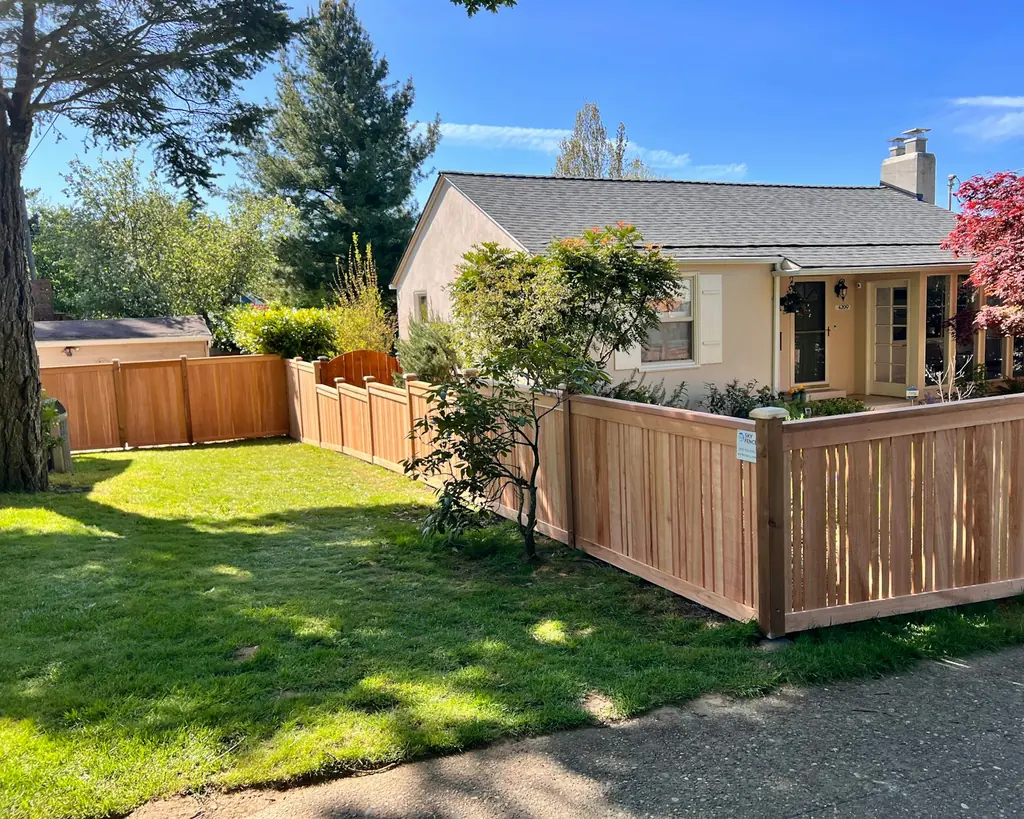
The American Kennel Club warns that jumpers and climbers can use the links in a chain link fence to scale up and over it. The Santa Fe shelter says chain link is easier to climb than a fence of vertical planks, and suggests fixing vertical wood planks or panels to the inside of a chain link fence you already have. A solid privacy fence in wood or vinyl, with the rails on the outside, gives a climber the least to work with.
Diggers: block the ground line
A fence is only as good as its bottom edge. The sources agree on the fix and differ a little on depth:
- The AKC suggests strips of metal, cement or large rocks one to two feet below the fence line.
- Best Friends says to bury fencing 18 to 24 inches deep, or attach fencing to the bottom of the fence and lay it flat on the ground at least 12 inches into the yard. It stresses doing the whole perimeter, or the dog will find the gap.
- The Santa Fe shelter suggests a chicken wire skirt attached to the base, running at least two feet into the yard and covered with rocks or ground cover.
Anything buried means digging along the line, so call 811 first.
Gates are where most dogs get out
Best Friends suggests clipping the gate latch shut with a carabiner, a lock or an old leash clip, and hanging a sign asking visitors to clip the gate. The San Diego Humane Society says everyone in the house and every visitor should know the dog gets out and check that gates are closed, and to patch any holes in the fence. When you get quotes, ask for a self-closing hinge and a latch the dog can't nose open.
What about an invisible fence?
Electronic or underground fences cost less than a physical fence, but MSPCA-Angell discourages them. It says they don't keep other animals or wildlife out the way a real fence does, and that a dog that has run through the boundary is unlikely to cross back and take another shock to come home. The AKC's guide to dog fences adds that you need a tall fence with bottom barriers to stop both jumping and digging.
A short fence for a temporary fix
Fixr's picket fence guide says temporary dog fencing runs about $90 to $100 for a section 7.5 feet long, but notes it may not be secure for a dog that runs, jumps or tries to escape.
What to tell the installer
Say how your dog gets out: jumping, climbing, digging or the gate. Ask for the height your city allows, a dig barrier priced as its own line on the quote, and a self-closing gate. Our calculator gives you a range to compare quotes against, and the materials guide covers upkeep.
Sources: Santa Fe Animal Shelter and Humane Society: Escape Behavior in Dogs (PDF); American Kennel Club: Types of Dog Fences (updated January 2026); Best Friends Animal Society: How to stop dogs from escaping; San Diego Humane Society: Escape behavior in dogs; MSPCA-Angell: position on electronic dog containment systems; Fixr fence installation costs (January 2025); Fixr chain link fence costs (January 2025); Fixr vinyl fence costs (January 2025); Fixr picket fence costs (January 2025).
Common questions
How tall should a fence be for a dog?
The Santa Fe Animal Shelter and Humane Society says 6 feet keeps most average sized dogs in. For a jumper that is still getting over, it suggests coyote rollers or an inward-tilting topper.
Is chain link good for dogs?
It is affordable and fine for many dogs, but the AKC warns that climbers can use the links to scale it. Fixing vertical boards to the inside makes it harder to climb.
How do I stop my dog digging under the fence?
Bury a barrier along the whole fence line. The AKC suggests metal, cement or large rocks one to two feet down; Best Friends suggests fencing buried 18 to 24 inches deep or laid flat at least 12 inches into the yard.
Are invisible fences a good idea?
MSPCA-Angell discourages them. They do not keep other animals out, and a dog that runs through the boundary often will not come back across it.
What fence is best for a dog that climbs?
A solid fence of smooth vertical boards or vinyl panels with the rails on the outside, so there is nothing to grip.
Rules and quotes in your city
Each city page lists that city's own height and permit rules, with links to the code, and takes quote requests.