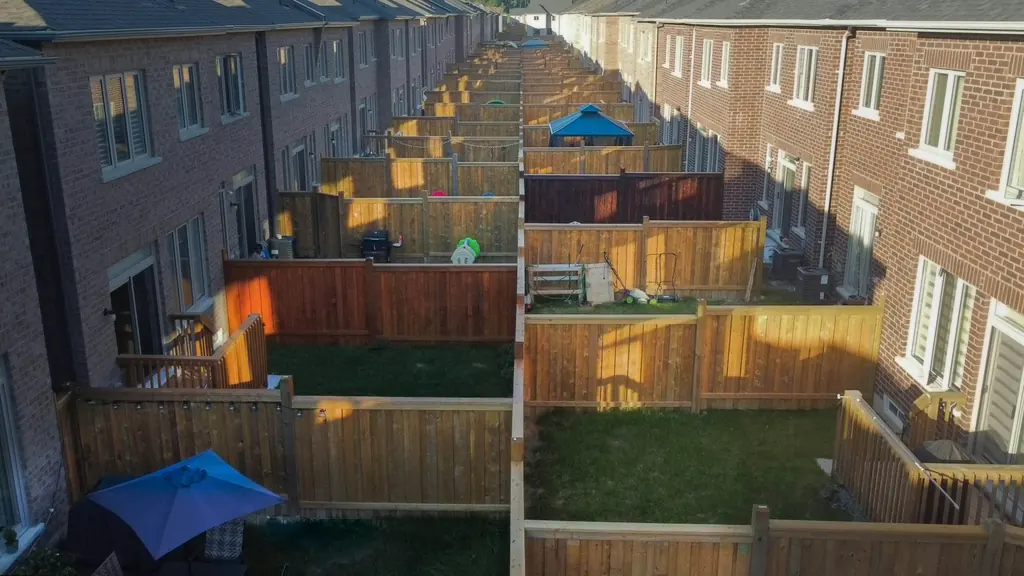
A fence built over the line can start a boundary dispute with your neighbor. Find the line before anyone sets a post.
Finding the line
- Look for the pins. Franklin County, Washington tells homeowners there should be property pins at each corner of the lot. They are often metal stakes in the ground, and Inver Grove Heights, Minnesota notes a metal detector can help find them.
- Check the paperwork. A recorded survey or plat may show your lot's dimensions. Some cities keep surveys on file, so ask.
- Don't measure from the curb. Along a road, the line is at the street right-of-way, not the curb.
- Hire a surveyor if you can't find it. San Mateo County, California says a boundary survey is how you locate the line.
Why it matters
The Texas A&M Real Estate Center points out that a new survey may put the boundary on either side of an existing fence, and that fighting a boundary dispute in court can cost more in time, fees and ill will than it gains. Neighbors can instead sign a formal boundary line agreement that treats a feature like a fence as the line. The Texas State Law Library adds that adverse possession is rare, but it is a legal concept that can let a trespasser, most often a neighbor, gain title to someone else's land.
Some places set the rule outright. Franklin County says no part of a fence or post may cross the line, encourages keeping the fence back from it so it can be maintained, and says the county does not locate lines or settle disputes over misplaced fences.
Which side faces out
Some cities set which side has to face out. Inver Grove Heights requires the finished side to face away from the property being fenced, and Biloxi, Mississippi requires it to face the lot's perimeter. Check your city's code.
Who pays for a fence on the line
It depends on the state, and the laws often cover less than you might think:
- Texas has no state statute on boundary fences between neighbors. A landowner generally doesn't have to share the cost of a fence the neighbor builds on the line unless they agreed to.
- Minnesota's equal-shares partition fence rule applies when both pieces of land are used for livestock.
- Ohio's partition fence chapter doesn't apply to lots inside cities and villages, or to land laid out into lots outside them. Where that chapter applies, Ohio State University Extension notes Ohio requires 28 days' written notice to a neighbor before removing a shared line fence.
- Florida: the University of Florida's extension handbook says neighbors generally have no legal duty to fence the shared line, and the owner who builds one has no claim against the neighbor for part of the cost unless the neighbor agreed to pay.
- Kentucky's division fence statute is for land used for agriculture: a farm owner can ask the district court to order a shared fence, with the cost split in half unless the court finds that unconscionable.
- Washington's partition fence law says a neighbor who later uses an existing fence to enclose their own land pays the owner half the value of the shared part. The chapter defines a lawful fence as at least four barbed wires, so it is written with farm fencing in mind.
- Nebraska's division fence statute says adjoining owners each build and keep up a just share of a division fence, which unless they agree otherwise means an equal burden. It does not force anyone to build a fence if neither owner wants one.
The common thread: outside of a written agreement, most of these laws were written for farm and livestock land. Talk to your neighbor before the fence goes in, and if they agree to share, put it in writing. Laws change and courts read them in different ways, so for a real dispute ask a local attorney.
Texas A&M's Real Estate Center recommends putting any boundary agreement with a neighbor in writing.
Sources: Franklin County, WA Planning and Building: Fence Placement Requirements (PDF); City of Inver Grove Heights, MN: Fence handout (PDF); County of San Mateo, CA Public Works: Fence Permit; Texas A&M Real Estate Center, Publication 1833: Whose Line Is It Anyway? (PDF); Texas State Law Library: Neighbor Law, Fences and Boundaries; City of Biloxi, MS: Build or mend your fences correctly (2021); Minnesota Statutes 344.03, Partition Fences: Expense; Equal Shares; Ohio Revised Code Chapter 971, Partition Fences; Ohio State University Extension Farm Office: boundary fence law; University of Florida IFAS Extension FE106: Handbook of Florida Fence and Property Law, Adjoining Landowners; Kentucky Revised Statutes 256.042, Division fences for agricultural land; Revised Code of Washington 16.60.020, Partition fences; Nebraska Revised Statutes 34-102, Division fences.
Rules and quotes in your city
Each city page lists that city's own height and permit rules, with links to the code, and takes quote requests.